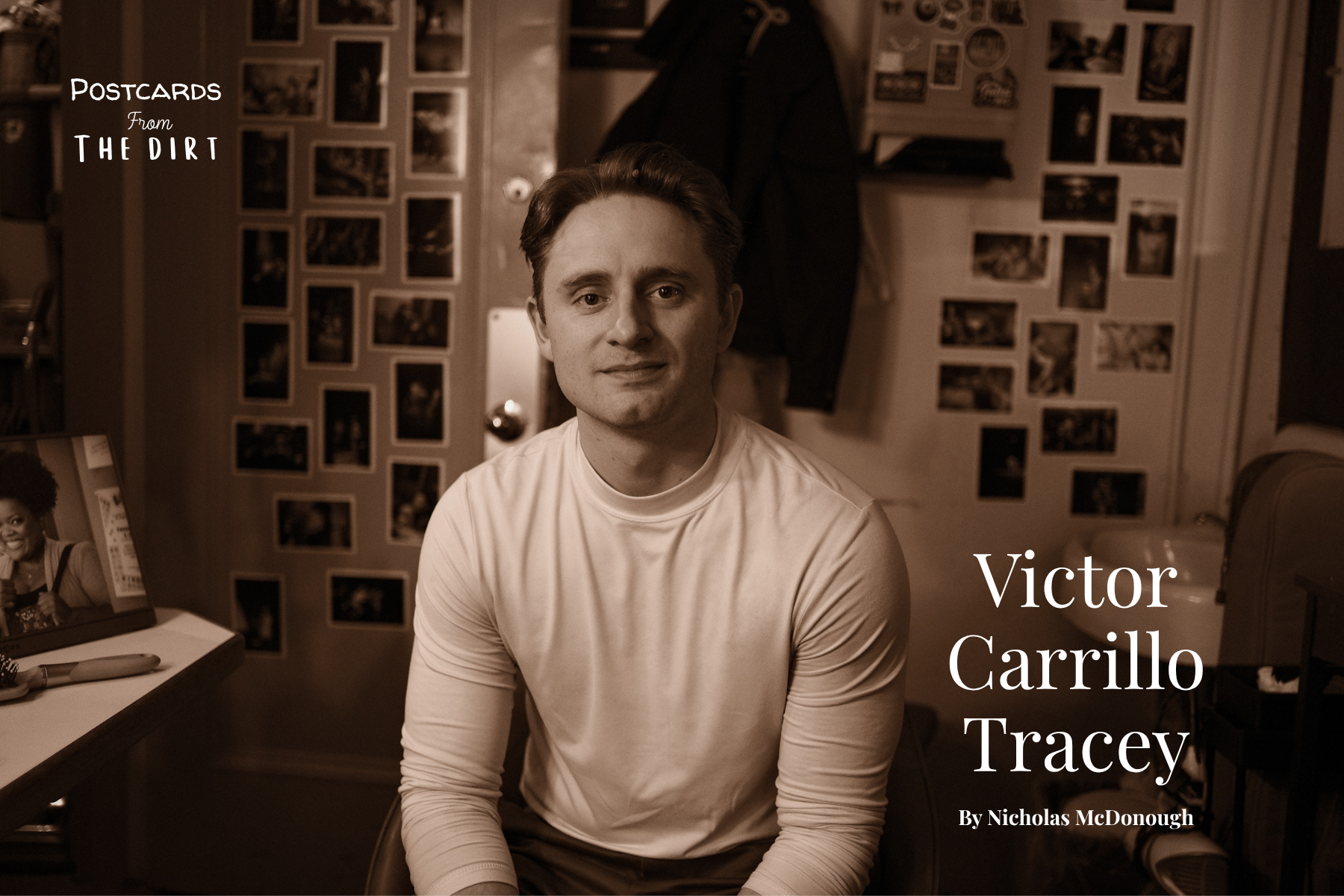
Victor Carrillo Tracey
VICTOR CARILLO TRACEY
Postcards from the Dirt
Interview and photographs by Nicholas McDonough
There is something strange about saying goodbye to someone in the theater. One night, they take their final bow, the company gathers around them, and everyone says their goodbyes. The next day, the show goes on.
I had the pleasure of sharing the stage with Victor Carillo Tracey during our time in The Outsiders. An original member of the Broadway company, Victor spent nearly two years with the show, first as an offstage swing and later playing Paul. He was there before the show opened, watched it become a success, and eventually made the decision to leave.
Having shared the stage with him, I knew one version of Victor. But I was curious about the experiences that brought him there, the little rituals that made the theater feel like home, and what it meant to walk away.
I caught up with him shortly after his final performance, while he was traveling through New Mexico.
THE BEGINNING
MCDONOUGH: What was your audition process like?
TRACEY: I auditioned for every iteration of the show.
Miranda actually sent me my audition tapes on my last day.
I auditioned for the first workshop and didn't hear anything.
I auditioned for the out-of-town production, and that didn't work out.
I think everything happens at the right time for the right reason.
I don't think I was ready, or there wasn't a place for me in the show that would have taught me everything I needed to learn until Broadway.
That's what I truly believe.
MCDONOUGH: And when Broadway finally came around?
TRACEY: I think I had five or six auditions. It was crazy.
I auditioned as a swing. There was a dance call, and then I did material in front of the creative team.
Then I did this huge packet because of all the roles I was covering.
And after that, I did the whole huge packet again in front of the producers.
MCDONOUGH: When you were auditioning, did you have any sense that the show was going to take off? Or was it just another audition?
TRACEY: When you're trying to get your first Broadway show, you're kind of throwing spaghetti at the wall.
But I felt like it fit me well when I started getting into the room.
The first time I saw the choreography, it was almost all Rumble-style choreography.
The first thing they wanted to see was how you could throw a punch and defend yourself.
I remember thinking, "Okay, this feels appropriate for me as a performer."
And then, when I was in the room with Danya for the third time, that's when I started to think I might get the job.
We just clicked.
The conversation was so natural. We talked for maybe ten minutes before we even started working.
I remember thinking, "Oh, right. I have to do the audition now."
MCDONOUGH: When did you realize the show was going to be a big success? During rehearsals? After opening? Around the Tonys?
TRACEY: Somewhere between those.
I think as performers, we all had hope, but there's an inherent bias because we're working so closely on something.
But I had an interesting perspective because I wasn't onstage.
After the first couple of previews, the first people who really made me think it was going to be something were the ushers.
The house staff.
They were saying, "This is really good. This is going to stay here for a while."
And they've seen a lot of shows come in and out.
The fact that they went out of their way to say how impressed they were carried a lot of weight.
FINDING HIS PLACE
MCDONOUGH: You spent almost two years as an offstage swing. How did moving into Paul full-time happen?
TRACEY: I'd played my part as an offstage swing for almost two years, which was amazing.
I learned so much.
I'm really grateful I had that perspective because I think it was the right way for me to do this show.
But I was debating staying or leaving, and I knew I wasn't really comfortable staying in my current position.
So when they offered me Paul, I already knew I was closing this chapter.
I felt like the universe was telling me that.
And I thought it would be a great way to bookend my time there.
MCDONOUGH: Was it important to you to finish your time with the show onstage?
TRACEY: Very.
I'd had this vision of taking my last bow on that stage.
And I knew I wasn't in my street clothes.
I don't know why.
It's such a silly, tiny thing, but I wanted to do the show on the day that I left.
And I wouldn't necessarily have been able to do that as a swing.
It was super important to me.
MCDONOUGH: What do you remember about your final performance?
TRACEY: I'll never forget it.
I was so emotional.
It was almost like my Broadway debut. I kind of blacked out.
I literally had to look at videos afterward because I was at such a high emotional level that consciousness took a back seat.
THE LITTLE RITUALS
Eight shows a week has a way of turning the smallest things into traditions. The same hallways, the same people, the same moments in the show. Over time, a routine becomes something more personal.
For Victor, some of those routines were nonnegotiable.
MCDONOUGH: What's something about your day-to-day life at the theater that an audience member would never think to ask?
TRACEY: There are a lot of things.
I'm superstitious.
Very superstitious.
I will not put my yellow sweater on until standby is called.
When I first started covering Paul, it was May or June of 2024, and it was really hot.
I had the sweater on the hook, and I didn't put it on until standby.
And then I realized that was what I'd been doing every time.
So now I will never put it on before standby.
I think I've done it by accident once, and I was like, "Oh my God, I'm not doing this."
I took it off and put it back on.
MCDONOUGH: Any other rituals?
TRACEY: There's a moment during "Hopeless War" when we're all up there.
There's this electric-guitar sound in the music, right before Emma sings.
And we all meet at that spot.
It started maybe a year and a half ago.
We do this ridiculous air-guitar thing together, like we're playing a guitar from our crotch.
It has to happen.
MCDONOUGH: [Laughs.]
TRACEY: If somebody doesn't make it up there in time, I'll shun them for the rest of the show.
MCDONOUGH: Do you think any of those superstitions will follow you into Evita?
TRACEY: There'll be new ones.
I'll find the superstitions as I go.
I do have to do some kind of acknowledgment or prayer or moment of gratitude before a show.
I've always done that.
At The Outsiders, part of that was physically carving my family name into the set.
I don't think they're going to let us take a knife to the Evita set, but we'll see.
LEAVING HOME
For almost two years, Victor returned to the same building, surrounded by the same people, performing the same story. Then came his final performance.
There's an odd contradiction in theater: something can mean everything to the people inside it, while continuing almost unchanged after they've gone.
MCDONOUGH: We've talked about this before, but how do you feel about leaving and moving on?
TRACEY: I made a big mistake.
I made a huge mistake.
[Laughs.]
No, I'm so happy with the time I had. It felt completely appropriate for me.
It's weird.
Really weird.
Something like that takes such precedence over your social life, your mental life, everything.
It's your whole life when you're in that building.
And then to suddenly drop all that importance and not see people who feel like family members every day is really strange.
I don't think it'll fully hit me until I'm doing something else.
But it was definitely my time.
MCDONOUGH: Because it feels like home.
TRACEY: Yeah.
I'd catch myself taking out my keys at the stage door without thinking.
That's how much it felt like home.
MCDONOUGH: There's something strange about watching someone have this enormous goodbye, taking their final bow, and then everybody else just coming back to work the next day.
It's such a pedestrian, everyday thing.
The show just keeps going.
TRACEY: I think it's beautiful.
We experienced that a lot when I was there, and I think it's really beautiful.
No matter how much of an original company member you were, or whether you were on the poster, the show goes on.
The show is bigger than anybody.
It's bigger than anybody.
There's never been a name above the title.
And I think that's why it continues to resonate with people and why it continues to put out good performances.
The show is the show.
A FEW OTHER THINGS
MCDONOUGH: What's a passion of yours outside theater?
TRACEY: Snowboarding. I used to go snowboarding all the time.
MCDONOUGH: What's your favorite form of art outside theater?
TRACEY: Movies.
MCDONOUGH: Movies? From when you were a kid?
TRACEY: Yes. My father's a documentary filmmaker. I love documentaries. I love film at large, but documentaries especially.
I used to watch documentaries with my family all the time at home. My sister and I would be like, "Let's watch Shrek 2," and my dad would be like, "Let's watch this documentary from France that just came out."
And then we'd end up loving it.
MCDONOUGH: What's your favorite decade?
TRACEY: The '80s.
MCDONOUGH: You know those wooden toothpicks they put in sandwiches? Pro or con?
TRACEY: Con. Get the wood out of my sandwich.
MCDONOUGH: Backpacks or shoulder bags?
TRACEY: Backpacks.
MCDONOUGH: When you're in an airport and they have those flat escalators—the moving walkways—do you take them or walk?
TRACEY: [Answer unclear in original transcription.]
Airports are one of my happiest places ever.
MCDONOUGH: Really?
TRACEY: I think you're either one of two people in an airport. You're at your worst or you're at your best.
And I'm at my best in the airport. I literally cannot wait to go to the airport.
MCDONOUGH: Do you get there early and hang out?
TRACEY: I get there, like, three hours early. I'll go to the Centurion Lounge.
I watch the planes. I love the possibilities. People going everywhere. I love it.
WHAT COMES NEXT
MCDONOUGH: This is how I think I'm going to end all of these interviews.
If you could design the next five years of your life with no limitations, what would happen?
TRACEY: I think I'd like to leave it a little vague and let the universe fill in what's best for me.
I'd be choosing my projects and working on things that make me extremely passionate.
I'd be living a more sustainable everyday life, having the time to recharge and do different things.
I don't know where I'll be.
MCDONOUGH: I like that. Some people have really specific checklists.
TRACEY: I like to leave it up to God and the universe because I think I know best, and then it shows me a different direction.